
Join Us for UNSUNG
OCO Presents:
UNSUNG
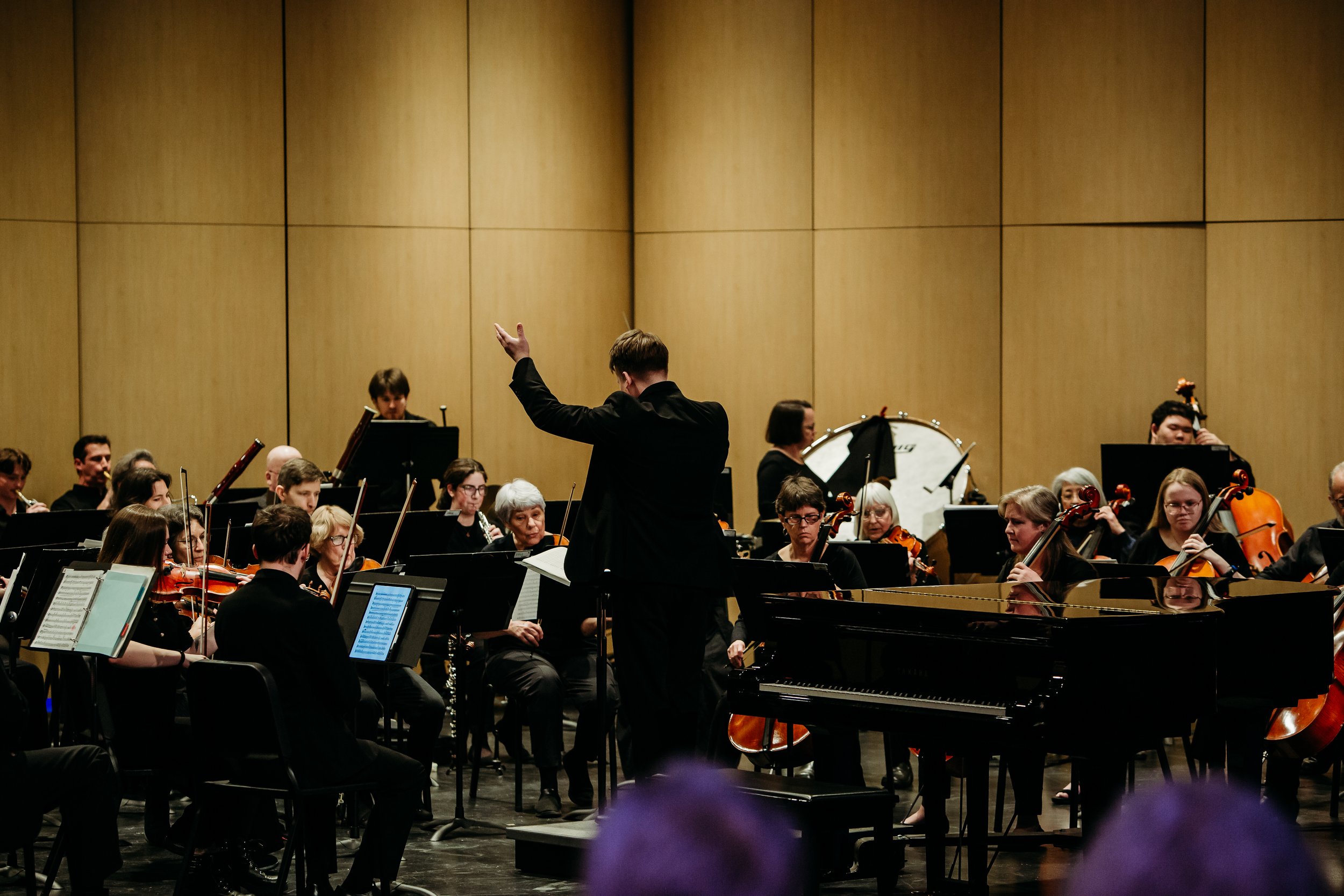
Come join us for our final concert of our 2025-2026 season! Our concert, UNSUNG, features the orchestral works, including overtures, intermezzi, and dances, from operas, showcasing the least seen but most often heard “character” in these stories.
We provide some in-depth look at the pieces we are featuring on our concert, UNSUNG, brought to us by Patricia Krafcik, Second Violin.
While music directors might choose to include an opera overture or intermezzo among other works in a single performance, this concert offers a unique opportunity to explore a handful of overtures and intermezzi in the context of one performance. Our selections range from Mozart’s “Overture” from Don Giovanni, performed as 18th-century Europe teetered on the brink of the French Revolution, to Puccini’s “Intermezzo” from Suor Angelica, premiered just a month before an armistice was signed ending the hostilities of World War I.
During this stretch of almost 150 years, we witness the flowering of the overture and intermezzo as they passed through the hands of some of the greatest opera composers of all time. Our concert order this afternoon, however, is determined not by date, but by the conductor’s choice. Most of the overtures will be played before intermission, except for Strauss’s overture to Die Fledermaus which will send us waltzing our way home. The four intermezzi immediately after the Intermission (Puccini, Massenet, Mascagni, Smetana) will be played as if they were segments of a single suite.

The Overture
The opera overture—a term taken from the French ouverture/“opening”—emerged as a discrete piece of music appended to early operas in the 17th century and functioned largely to quiet enthusiastic audiences. Overtures gradually began to resonate more closely in a musical sense with the operas to which they were linked. With Mozart’s Don Giovanni (1787), the overture already began to set the tone of the opera itself which traces the path of the rakish womanizer Don Juan from his misadventures to an inevitable and terrible doom. Two ominous opening minor chords, perhaps a foretaste of the frightening supernatural activity of the opera’s stone statue come to life, initiate a brief sinister-sounding introduction that gives way to a brisk molto allegro. From there to the end, intermittent major and minor passages and sharply alternating forte and piano moments heighten the tension inherent in the darkly “comic” story that awaits the audience. Hereafter, audiences surely anticipated that overtures would offer hints of what lay ahead, echoing music within the opera and mirroring the story.
Verdi, Beloved of Italian Patriots
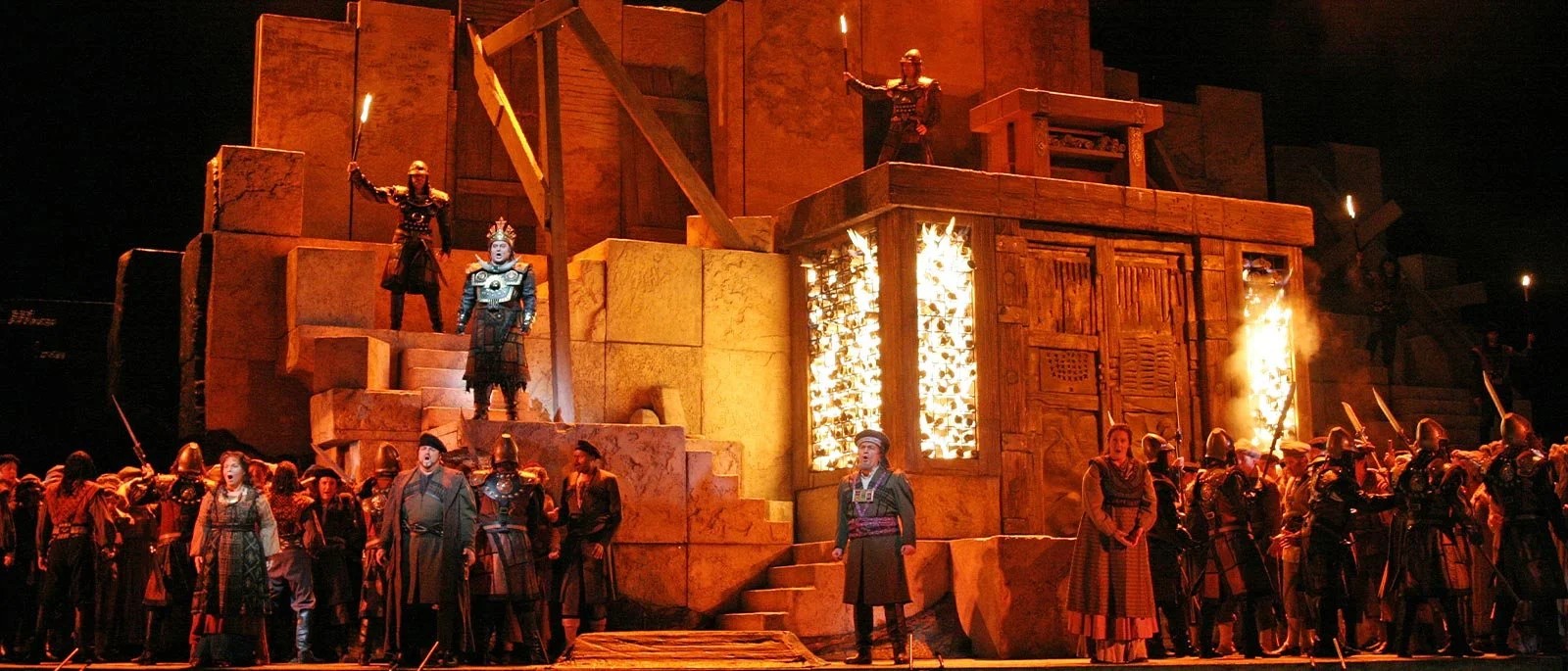
An image from the Metropolitan Opera’s production of Verdi’s Nabucco, February 2005 (Source)
Opening our program, however, is not our earliest example, Mozart, but rather Verdi, with his “Overture” from Nabucco (1841)—the title an abbreviated form of the name Nebuchadnezzar II, a king of the Neo-Babylonian Empire in the first half of the 6th century BCE. Nabucco’s character is a composite of rulers, and the opera’s story is loosely drawn from Old Testament references to the plight of the Israelites conquered and enslaved by the Babylonians under Nebuchadnezzar II and ultimately released. The overture begins with a regal introduction by horns and brass interrupted by the strings tracing an ominous chromatic pathway toward an intensely pulsating rhythmic allegro passage, perhaps an expression of the captives’ deep anxiety. But soon, among other themes drawn from the opera, we hear a musical statement of what has become one of the most cherished songs in Italian opera, “Va, pensiero”/Fly, thought! This chorus is sung by the Israelite slaves as they mourn for their homeland. There is nothing Middle Eastern in this melody, but everything quintessentially and romantically Italian, and indeed, the song was adopted by 19th-century Italian patriots as their anthem in their quest to liberate their country from foreign rule and unify all its diverse regions.
Rossini, Master of the Overture
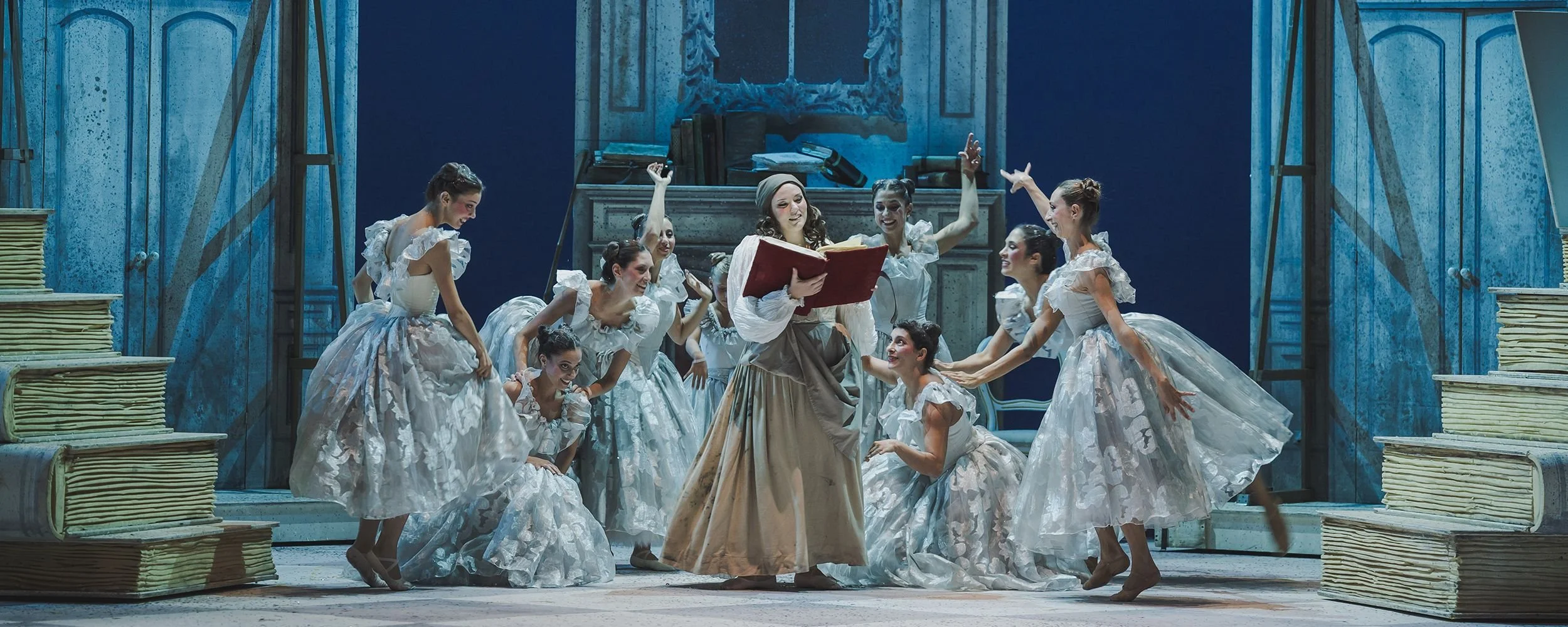
This image features a production of Rossini’s La Cenerentola from Teatro del Maggio, Florence, Italy
September 2024. (Source)
Verdi was most definitely an Italian patriot supportive of the Risorgimento, that 19th-century political and social movement whose efforts indeed led to the unification of Italy by 1861, with the designation of Rome as capital in 1870, and the gathering in of the final Italian provinces at the close of World War I. Rossini, whose Overture to La Cenerentola (1817) is next in our program, was not overtly political in the same sense, but like Verdi he was a master of opera overtures perfected over the thirty-nine operas, comic and serious, that he composed. La Cenerentola, a somewhat revised rendition of the Cinderella tale, is in the Classical tradition of “opera buffa”/comic opera, and the light-hearted tone of the overture’s themes conveys this successfully. Listen for what one critic called the “rapid-fire string work,” and also for the characteristic “Rossini crescendo” heard in a few passages in the overture. In that special crescendo, which became a hallmark of his compositions, Rossini repeats a melodic and rhythmic phrase, each time increasing volume and often in a higher instrumental register. Sections of the orchestra may also layer on in the repetitions enhancing dramatic excitement.
French Horn to the Rescue in Oberon
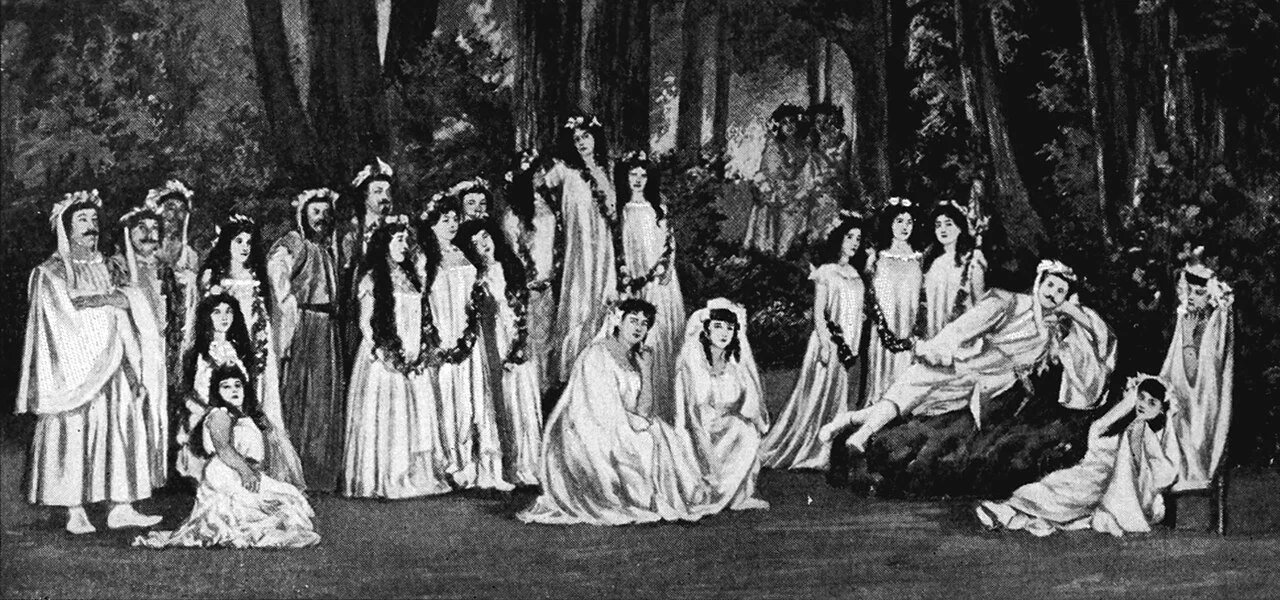
Illustration of Weber’s Oberon from "The Victrola book of the opera: stories of one hundred and twenty operas with seven-hundred illustrations and descriptions of twelve-hundred Victor opera records" (1917) (Source)
After listening to Mozart’s Overture to Don Giovanni, mentioned above, we move to von Weber’s Oberon (1826). Originally cast in English, this immensely popular opera was quickly translated into German and is largely performed in that language. Under the influence of Romanticism’s emphasis on love relations and exotic phenomena, the story revolves around Elf-King Oberon, his wife, and their debate about marital fidelity. The fairy and human worlds intersect as a magic horn summons Oberon and his wife to rescue true lovers from a death sentence in Baghdad and ultimately to transport them to the safety of the court of the Holy Roman Emperor Charlemagne. That horn literally introduces the overture, resounds yet again, and links the overture to the rest of the opera. The delicate fluttering of flutes and strings suggests the fairy world in a breathy opening section, and a breathtaking allegro con fuoco follows, relieved by only a short section of romantic calm before speeding to a final flourish.
The Intermezzo
An essential element in traditional operas is the intermezzo, placed between acts or scenes, named from the Italian “interlude” or metaphorical “bridge,” generally equivalent to the “entr’acte,” from the French, “between acts.” Intermezzi originally functioned as separate musical moments within a larger opera context often offering some comedic relief and with singers—even from the opera itself—employing disguises and slapstick to entertain the audience. Intermezzi continued to serve as moments of crucial transition, perhaps allowing stage crews to readjust scenery, but not simply just filling time. Rather, in high opera they provide an opportunity for a psychological or emotional transformation as characters move from one act or scene to another, and they drive the plot forward. Likewise, they allow the audience itself a moment to reflect on the unfolding story. Some intermezzi have become short and complete “mini-operas” in themselves performed apart from their larger context. Consider all this with regard to our intermezzi this afternoon.
Verismo in Opera
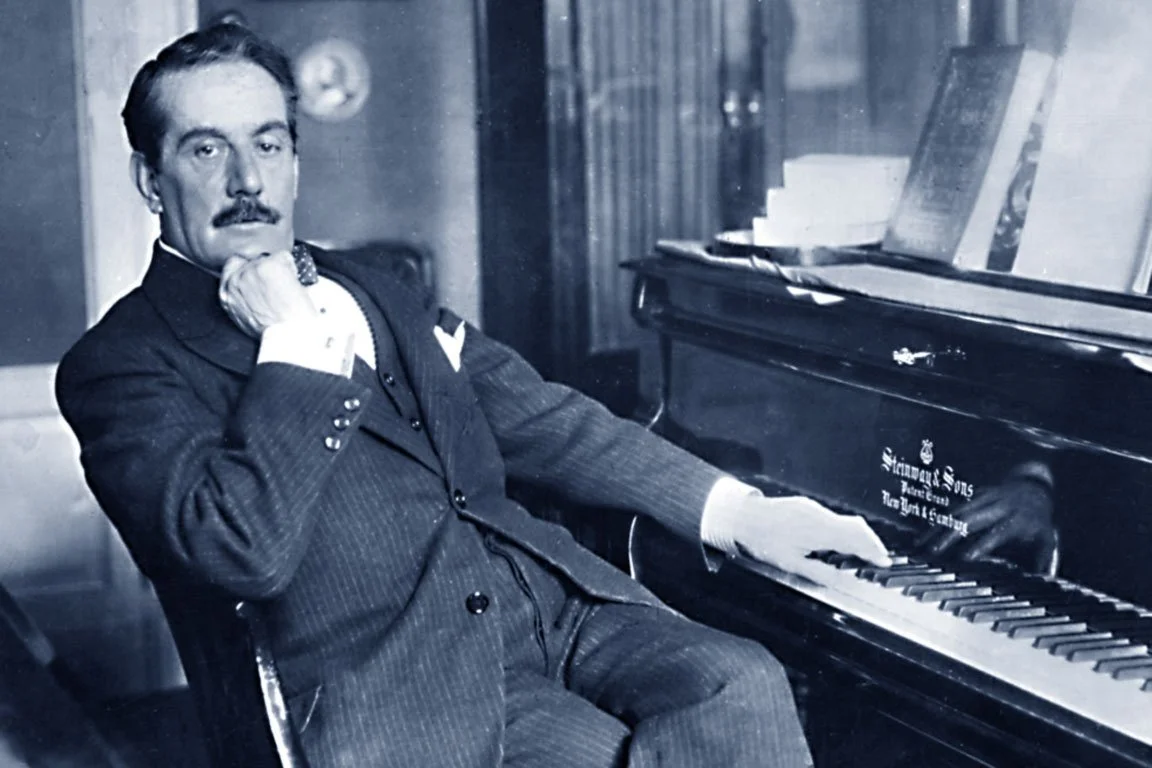
Pictured is Giacomo Puccini and his piano (1900), known for his verismo style in his works. (Source)
Operas by Puccini, Massenet, and Mascagni present us with a powerful quality of artistic expression that emerged from 19th-century Romanticism, spilling over from literature to music composition—Verismo, derived from the Italian verità/truth, and identified with Naturalism in the arts. The Verismo movement focuses on the expression of brutal truth, raw reality, portraying the struggles of ordinary people, a world away from the supernatural demonic elements of Don Giovanni, the fantastical world of Cinderella, the biblical-historical setting of Nabucco, and the fairy landscape of Oberon. Verismo exposes unbridled human passion, complete despair, jealousy, murder, intense spiritual devotion, all translated into the language of music in high opera. The verismo element within these operas is also explicit in their intermezzi as we experience in our selections this afternoon.
Puccini
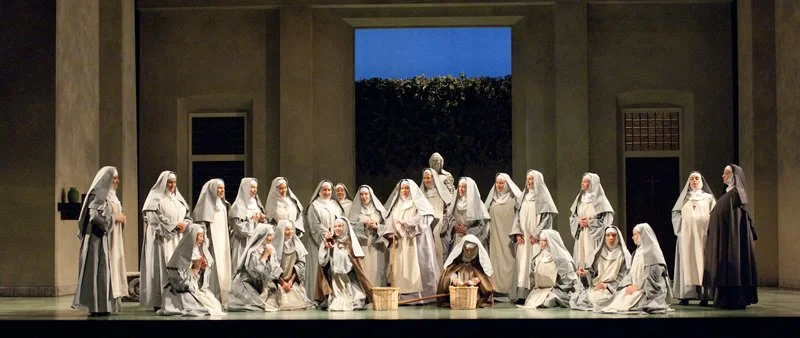
Pictured is Puccini’s Suor Angelica, performed by the Seattle Opera Company, 2012. (Source)
Puccini’s “Intermezzo” from his Suor Angelica (Sister Angelica, 1918) models the Verismo movement perfectly. Part of a triptych of one-act operas all dealing with death, Suor Angelica traces the tragic history of a young woman who is condemned by her family to life in an isolated monastery for bearing a son out of wedlock seven years prior. Angelica’s hopes to reconnect with family are dashed as she is compelled to sign over her portion of the family’s inheritance to her sister, at the same time learning that her young son has died. Utterly distraught, she imagines hearing him call to her. Puccini places the intermezzo precisely at that point just before the final moments of the drama. Angelica silently exits her monastic cell as the intermezzo begins with muted strings, but soon a wave of longing washes over her, expressed in sweeping arpeggios, including by harp, and a climactic con passione passage.
Driven by a burning desire to be reunited with her deceased son, she gathers flowers to concoct a poisonous potion. As the woodwinds intone a somber chant and alternate with the strings’ dark and ominous pizzicatto, Angelica sings to the flowers, reminding them of the care she afforded them, and how she expects them to help her now. This highly emotional intermezzo demonstrates how the genre operates as a transition, transporting both the protagonist and the audience into the final moments, tragic and also strangely comforting, for even as Angelica collapses to death, she is reunited with her child presented to her by the Virgin Mary.
Massenet
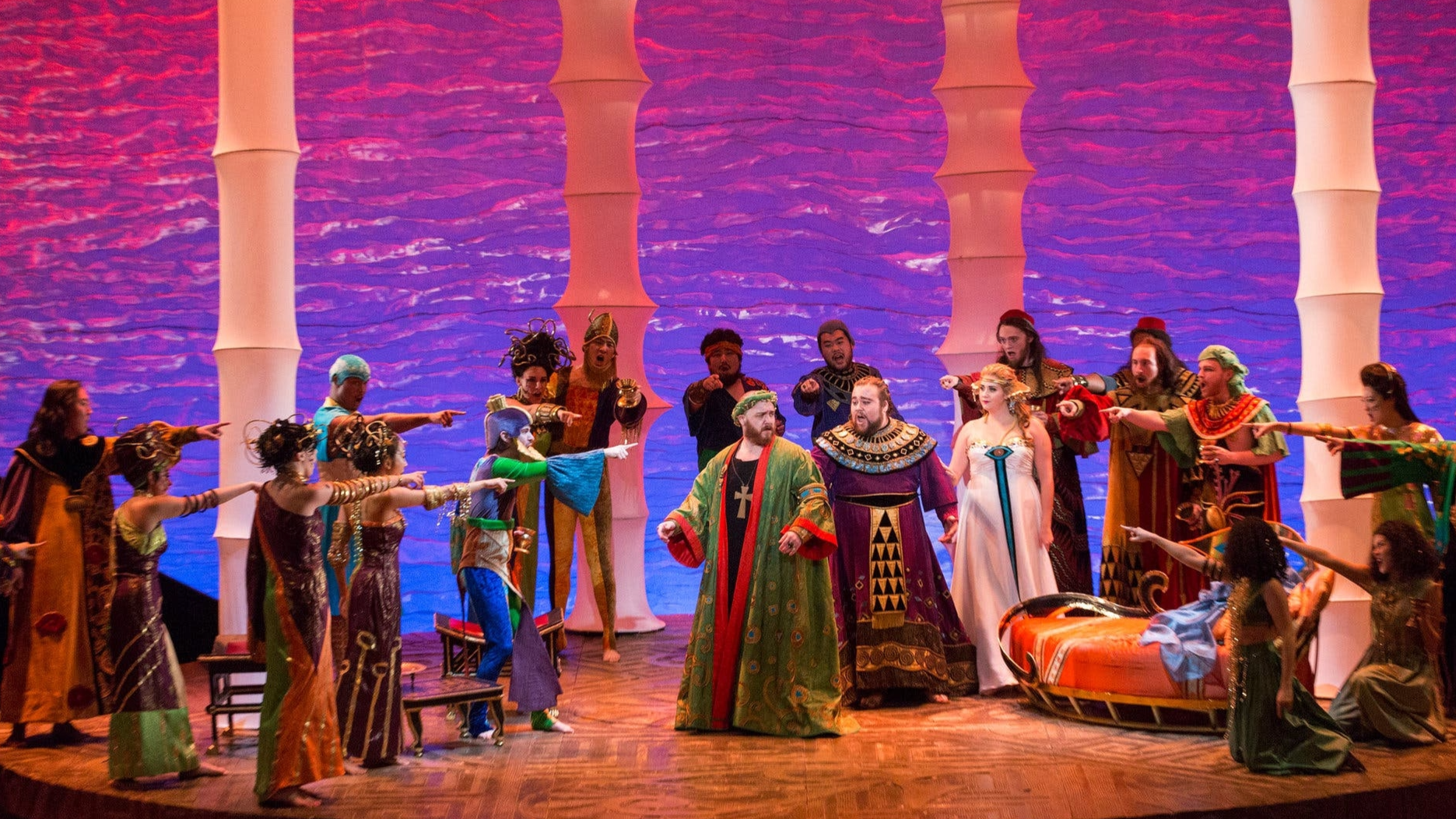
A performance by the Manhattan School of Music of Massenet’s Thaïs, 2012. (Source)
Surely, the “Méditation” from Massenet’s opera Thaïs (1894) is one of the best known of short violin solos frequently performed outside the opera, including in student recitals. Yet its original identity is as an intermezzo placed between scenes in the opera’s second act. Proud Egyptian courtesan, Thaïs is fraught with doubt about her way of life and fearful of her fate after death. Under the influence of a monk intent on guiding her toward repentance, she begins seriously to consider breaking from her self-indulgent and hedonistic past, converting to Christianity, and voluntarily entering a monastic life. The intermezzo tracts Thaïs’s actual spiritual journey toward conversion with the melody sung by solo violin accompanied by a harp and gentle orchestra—as if representing the voice of her soul. Indicated as andante religioso, the intermezzo begins calmly, evolves to appasionato and even agitato before returning to the sweet violin voice and calmato, thus resonating with her tortured path toward her new sacred and peaceful life. The intermezzo’s melody returns in fragments in the opera’s final scene shared by flute, violin, and Thaïs’s own inspired voice.
Mascagni
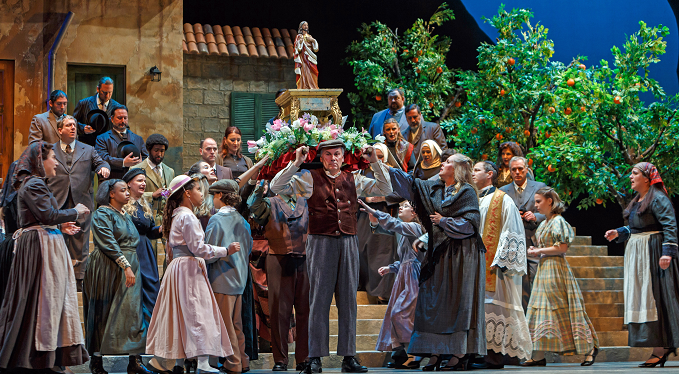
A performance of Mascagni’s Cavalleria rusticana by the Pittsburg Opera, November 2024. (Source)
Cavalleria rusticana (Rustic chivalry, 1890) is a fitting title for this emotionally challenging one-act opera set in Sicily on a single Easter Sunday morning. It premiered before both Massenet’s and Puccini’s selections here and is considered to have introduced the Verismo movement in Italian dramatic opera. The opera itself inspired film interpretations, including by the famous director Franco Zefferelli with Plácido Domingo as the main male character, Turiddu, and the opera’s exquisite intermezzo features in the finale of The Godfather Part III in which part of a performance of the opera itself also is employed. The opera’s plot centers on Turiddu just returned from military service to find his lover, Lola, married to Alfio. As revenge, he seduces a village girl, Santuzza, but then throws her aside when Lola’s jealousy brings her back to him and they resume their now illicit affair. Santuzza, in anger soon woefully regretted, reveals the affair to an incensed Alfio. At this point the intermezzo begins, echoing a hymn previously heard from inside the church. The gentle melody builds in intensity and volume to a forcefully accented few measures, anticipating the tragedy about to unfold, but the intermezzo ends in calm resignation at sempre pianissisimo. The villagers exit the church and gather in the square, wine is drunk, tensions rise, and a cuckholded Alfio challenges Turiddu to a duel. The town square clears. After the close of the intermezzo, shots are fired offstage and Turiddu’s death is announced, leaving his mother, Santuzza, and the community in despair.
Smetana, Father of Czech Music
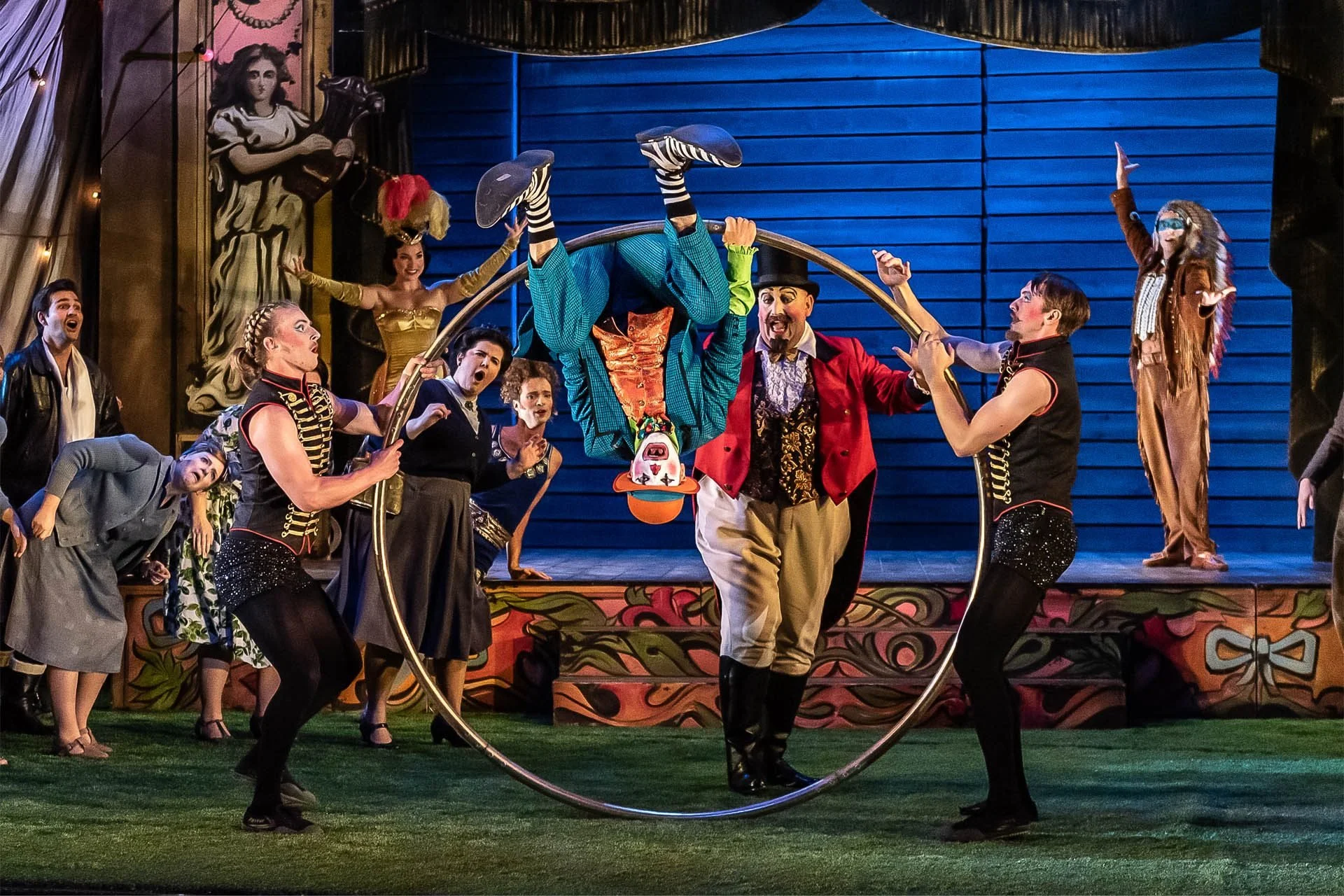
A production of Smetana’s The Bartered Bride performed by the Garsington Opera, the United Kingdom, June 2019. (Source)
With The Bartered Bride (Prodaná nevěsta/literally: The Sold Bride, 1866; revised and re-premiered in 1870), we leave the darkly passionate, even painful verismo of high Italian opera, and make our way north to central Europe, specifically today’s Czechia. In the nineteenth century’s European “Springtime of Nations,” the Czechs were among several peoples within the enormous multiethnic Austrian Empire and Hungarian Kingdom struggling to define and preserve their national identity in the absence of nation states. Nation-states would emerge only after World War I. Smetana, with his Bartered Bride and other compositions, was among composers who opted to be on the forefront of this national effort, drawing into their formal music various elements of their nation’s folk music and dance, folk traditions, and national history, and often centering on peasant life.
Set in a village, the opera story circles around a complex interplay of actions involving love, parents’ demands, a marriage broker, disguises, and misunderstandings, and ends with a clever and satisfying conclusion. In the original Czech, our selection, the “Dance of the Comedians” or “Entry of the Comedians,” was called simply “Skočná” which referred to the specific kind of folk dance that was done here. Smetana used two other types of folk dance elsewhere in his opera, the polka and the furiant (Dvořák did, too, in his Slavonic Dances). The skočná here in the second scene of the third act is linked with the arrival of a traveling circus. Its name comes from the Czech verb skočit, to jump, and this energetic dance includes jumping and leaping. An interesting observation here is that the “Dance of the Comedians” is an example of “diegetic music.” This is music played by the orchestra but intended as the actual music produced and heard by the actors as they dance and engage in their acrobatics on the stage. Thus, the music entertains both the opera’s audience and the actors and bystanders as part of the opera story. Listen for the repetition of the violins rapidly running the same scales over several measures at least three times during the piece along with abundant syncopation, all this contributing to an energetic and festive atmosphere.
Strauss, the Waltz King
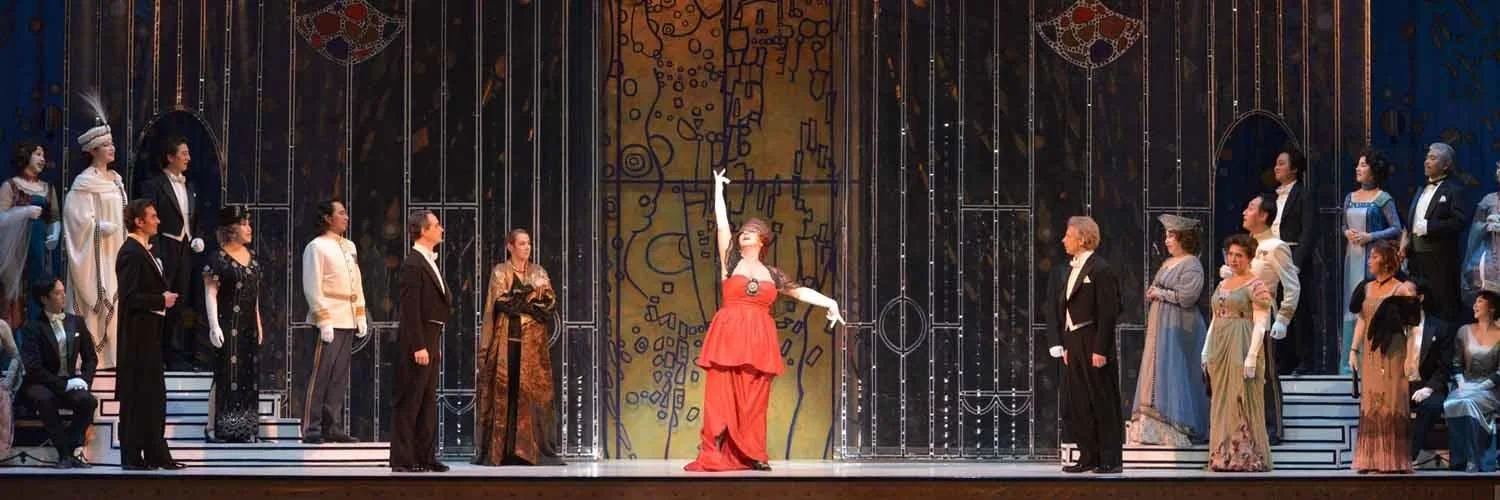
A performance of Strauss’s Die Fledermaus by the New National Theater, Tokyo, Japan, November 2020. (Source)
Our concert concludes with a final overture linked with one of the most famous of operas, Die Fledermaus (The Bat, 1874). The son of Johann I, our Johann II acquired greater fame than his father, although both were known for their elevation of the waltz to a genre worthy of inclusion in formal music. It is not surprising that the waltz, then, would play a significant role in Johann II’s operettas. The genre of the operetta emerged in Europe as a specific kind of musical production by the middle of the 19th century, and Johann II’s embraced the genre. Revolving around an entertaining story, the operetta included usually eminently singable melodies, spoken dialogue, and dance—a mix of items that eventually led to the creation of the modern musical theater.
Johann II based Fledermaus on a German literary farce involving a nasty trick played by one individual on his friend—namely, leaving him drunk and wearing a bat costume one night in a park in the town center where he became the “laughingstock of Vienna.” The embarrassed “bat” then takes revenge played out in the context of a New Year’s Eve drunken ball hosted by a Russian prince. Participants are disguised in theatrical costumes, identities are amusingly mistaken, alcohol fuels the festivities, a near-infidelity is forgiven, and the waltz is danced. Johann II’s overture draws on several melodies from the operetta, including a famous waltz with which audiences are usually familiar. There are several varieties of the waltz as a dance. What we hear in Die Fledermaus’s overture is the Viennese variant which occurs here first in G Major and is repeated later in A Major—a whole step up signaling greater intensity and excitement as the overture speeds to a close. Listen for an extremely brisk dance tempo and a slight “lilt” or pause on the second beat in some measures and imagine the dancing couples constantly rotating around each other as they sweep in a large circle around the dance floor. There is no rising and lowering motion as in the ordinary slower waltz, but only a steady and even glide across the floor. There is little doubt that we will all be humming this melody for a very long time.
Please join us with an incredible afternoon of music at our concert, UNSUNG.
